



For many owners, the business is more than a source of income. It is the result of years of work, risk, relationships, and decision making. That is why business succession planning should not be left until the year you want to sell, retire, or transfer ownership.
A strong succession plan helps you understand what the business is worth, how ownership may transfer, what tax issues need to be reviewed, how cash flow may change, and whether the next owner is ready to take over.
The goal is to preserve value, reduce surprises, and create a transition that works for the owner, the business, the family, and any shareholders involved.
Disclaimer: This article provides general information only; please consult a qualified tax professional for advice tailored to your unique situation.
What Is Business Succession Planning?
Business succession planning is the process of preparing for a future ownership or leadership transition. For an owner, this could mean selling the business to a third party, transferring it to family, bringing in employees, completing a management buyout, merging with another company, or gradually stepping away.
Succession planning usually includes tax planning, valuation, cash flow review, shareholder planning, financing considerations, and transition timing. It may also involve legal, estate, wealth, and family advisory support.
Bateman MacKay’s Business Advisory & Consulting Services include succession planning, business valuation, tax and estate planning, corporate finance, cash flow analysis, and strategic decision support.
When Should Succession Planning Begin?
Succession planning should begin before you feel ready to exit. If a sale or transfer is only months away, some planning options may be limited.
A useful time to start is when one of these questions becomes relevant:
- Do I want to sell the business in the next few years?
- Could a family member or employee take over?
- Is the business too dependent on me?
- Do I know what the company is worth?
- Would the business be attractive to a buyer?
- Have I reviewed the tax impact of a sale or transfer?
- Would my retirement plan work if the business sold for less than expected?
Starting early gives the owner time to improve profitability, clean up the corporate structure, review tax planning opportunities, strengthen management, and prepare the business for a smoother transition.
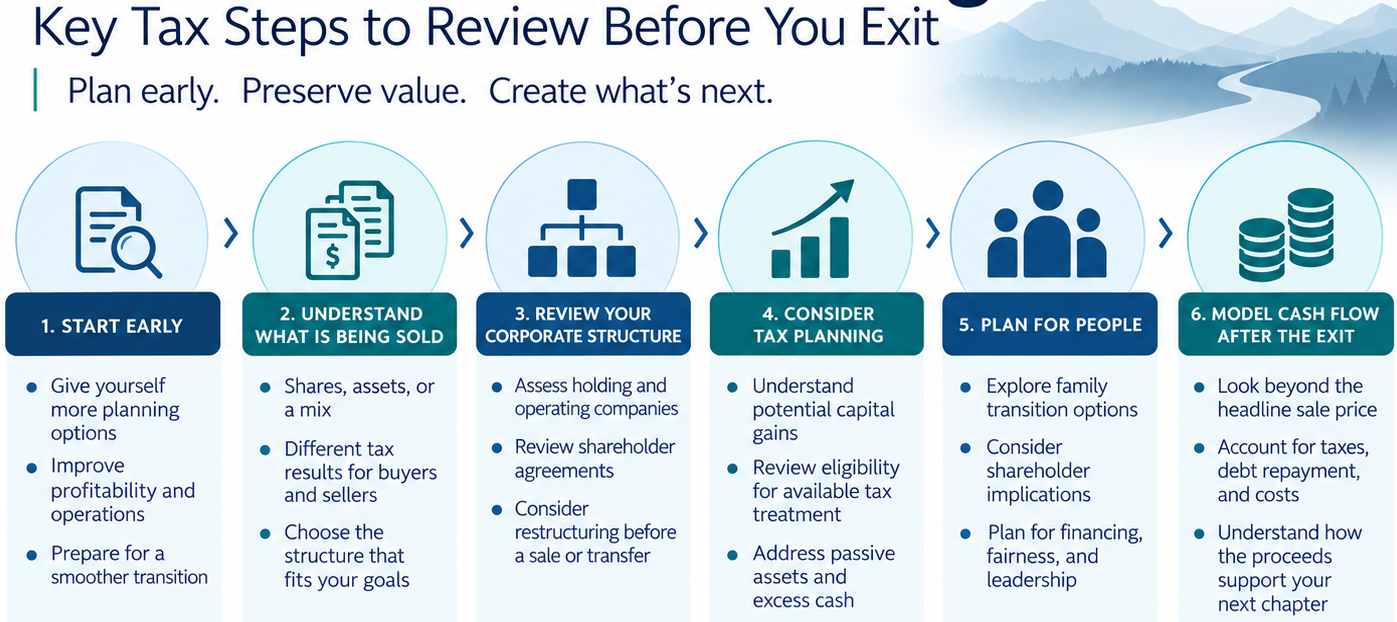
What Tax Steps Should Owners Review Before an Exit?
Tax planning is one of the most important parts of succession planning. The way a transaction is structured can affect the amount of tax paid, the timing of payments, and the cash available after the transition.
Before selling or transferring a business, owner managers should review the following areas with a CPA.
1. Understand What Is Being Sold
A sale may involve shares, assets, or a mix of both. Each structure can create different tax results for the seller and buyer.
A share sale may be attractive to a seller because the owner is selling the corporation itself. An asset sale may be preferred by a buyer because it can allow them to choose specific assets and limit certain risks. The right structure depends on the goals of both sides, the nature of the business, and the tax outcome.
Bateman MacKay’s Mergers & Acquisitions Advisory Services support business owners with deal structure, due diligence, valuation, financing strategy, and pre and post acquisition tax planning.
2. Review Corporate Structure Early
Many owner businesses evolve over time. What worked for daily operations may not be ideal for succession.
Before an exit, a CPA can review whether the corporate structure supports the intended transition. This may include reviewing holding companies, operating companies, shareholder agreements, related party balances, intercompany accounts, and whether any restructuring should be considered before a sale or transfer.
This review should happen early because last minute restructuring can create tax, legal, and timing issues.
3. Consider Capital Gains Planning
If the business is sold for more than its adjusted cost base, the owner may have a capital gain. Depending on the situation, planning may be available, but the business and shares must meet specific requirements.
Owners should not assume that every business sale will automatically qualify for favourable tax treatment. A CPA can help review whether the business structure, assets, shareholders, and timing support the intended tax result.
This is especially important if the corporation holds passive investments, excess cash, real estate, or assets that are not directly tied to the active business.
4. Review Family Transition Options
Family business succession can be rewarding, but it can also be complex. The owner may want to be fair to children who work in the business and children who do not. The successor may need time, financing, training, and authority. The outgoing owner may still need income after stepping back.
Tax planning, estate planning, valuation, and communication should work together. If one area is ignored, the transition can become harder than expected.
5. Review Shareholder Considerations
If there are multiple shareholders, succession planning should address what happens when one owner wants to exit and another wants to stay.
Important questions include:
- Is there a shareholder agreement?
- How will shares be valued?
- Can the company buy back shares?
- Will another shareholder purchase the exiting owner’s shares?
- How will the transaction be funded?
- What happens if there is a dispute?
- Are there insurance or financing arrangements in place?
These questions should be answered before a transition begins. Waiting until a shareholder is ready to exit can create pressure and reduce flexibility.
6. Understand Cash Flow After the Exit
A sale price is not the same as cash in hand. Taxes, debt repayment, transaction costs, deferred payments, vendor financing, and working capital adjustments can all affect the owner’s final outcome.
A CPA can help model different scenarios, such as a full sale, staged sale, family transfer, management buyout, or partial exit. This can help the owner understand whether the plan supports retirement, reinvestment, estate goals, or continued involvement in the business.
Bateman MacKay’s advisory services include cash flow analysis and financial projections, which can help owners assess whether an exit plan is realistic before they commit to it.
Why Valuation Matters Before You Exit
Business valuation is central to succession planning. Without a realistic view of value, it is difficult to plan taxes, negotiate with buyers, arrange financing, or create a fair family transition.
A valuation is not only useful at the time of sale. It can also help owners make better decisions years before they exit.
“Succession planning is about much more than finding a buyer. The way a business is structured, valued, and prepared for transition can have a significant impact on tax, cash flow, and the owner’s long-term financial outcome. Starting early gives you more planning opportunities and more control over how and when you transition your business.”
— Vinay Khosla, M.Acc., CPA, CA, Tax Partner & Chief Growth Officer, Bateman MacKay LLP
How Bateman MacKay Can Help
Business succession planning involves more than choosing a retirement date. It requires a coordinated review of tax, valuation, cash flow, ownership, financing, family transition, and transaction structure.
Bateman MacKay can help owner managers review:
- Business succession planning
- Business valuation considerations
- Tax and estate planning
- Corporate finance and cash flow
- Shareholder and family transition issues
- Deal structure for a sale or transfer
- Due diligence readiness
- Mergers and acquisitions advisory
- Pre and post transaction tax planning
For owner managers planning a sale, transfer, or long term transition, Bateman MacKay brings together Business Advisory & Consulting Services, Tax Planning, Consulting and Compliance Services, and Mergers & Acquisitions Advisory Services to support better decisions before, during, and after the transition.
Contact Bateman MacKay to speak with a CPA advisor about your succession plan.